
Key Takeaways
- The direct indexing vs. ETF decision is not about which vehicle is universally superior, but which is appropriate for a specific client segment and whether a firm's operations can support it.
- Total cost of ownership includes not only explicit expense ratios and platform fees but also the implicit operational costs a firm absorbs, such as time spent on rebalancing, reporting, and compliance review.
- Direct indexing shifts control to the individual account level, enabling lot-level control and customization but also increasing the complexity of rebalancing, trade management, and client communication.
- Firms may benefit from a segmentation framework that considers account size, tax status, and specific client needs (like ESG screens or concentrated stock management) to determine where direct indexing is warranted.
- Before adopting direct indexing at scale, firms can evaluate their operational readiness, including whether their reporting, rebalancing, and compliance workflows can handle lot-level data and transaction volume.
The debate over direct indexing vs. ETFs is often framed as an investment question: which vehicle delivers a better after-tax return? For advisory firms, however, there is an equally important operational question. What does each approach demand from a firm's workflows, reporting infrastructure, and client communication process? And which clients benefit enough to justify that complexity?
The answers to those questions can differ across a firm's client base. When implementation varies by client segment without a shared framework, a firm can end up with fragmented reporting and gaps in household-level analysis, which can make portfolio value harder to communicate clearly.
At the same time, direct indexing and ETFs are not mutually exclusive. Firms can use both, deploying them for different client segments and purposes. The real decision framework involves evaluating cost structure, operational readiness, and client segmentation together, rather than picking a winner in the abstract. This article provides a framework for that evaluation, examining the structural differences, total cost of ownership, and operational implications for the advisory firm.
How Direct Indexing and ETFs Differ at the Ownership Level
A key difference between direct indexing and an ETF lies in how each is owned, even when both track the same index. This structural distinction underlies many of the downstream differences in tax treatment, customization potential, and operational requirements. An advisor managing a client's large-cap equity exposure through an ETF manages the client's shares of a single fund wrapper; an advisor using direct indexing for the same exposure manages a portfolio of the individual underlying securities directly in the client's account.
ETF Wrapper Mechanics: Creation-Redemption and What It Means for Advisors
The tax efficiency of most index ETFs stems in part from their creation-redemption mechanism. Authorized participants transact directly with the ETF to create or redeem large blocks of shares by delivering or receiving a basket of underlying securities, often through in-kind transfers that can help the fund manage capital gains exposure more efficiently than a traditional mutual fund. Ordinary investors, by contrast, generally buy and sell ETF shares on the secondary market rather than transacting directly with the fund.
For advisors and their clients, this structure can provide tax efficiency at a collective fund level. However, it also means individual security selection, lot-level management, and trading activity within the fund sit with the fund rather than with the advisor. The client owns the ETF wrapper, not the underlying stocks. This makes ETFs a simple, scalable tool for gaining market exposure, but that simplicity comes at the cost of individual-account customization.
Direct Indexing Ownership: Individual Securities and Lot-Level Control
Direct indexing, by contrast, replicates an index by purchasing the individual securities, or a representative sample, directly in a client's separately managed account (SMA). The client owns the actual stocks, not shares of a fund. This structure provides direct, lot-level control. An advisor or overlay manager can act on individual positions, such as excluding certain securities to align with a client's values, managing a concentrated stock position , or working with a client's tax professionals to evaluate account-level tax tradeoffs.
That ownership structure can create additional tax-management opportunities beyond the tax efficiency typically associated with ETFs. Because the client holds individual securities, advisors and specialized platforms may be able to evaluate security-level tax-loss harvesting opportunities, manage individual tax lots with more precision, and customize implementation around existing low-basis or concentrated positions. Those potential benefits vary meaningfully by client circumstances, account history, embedded gains, turnover, and tax status, and they are not guaranteed.
The "customization" advantage of direct indexing, such as sector exclusions or ESG screens, typically introduces tracking difference relative to the benchmark, and that difference can widen over time. Firms may monitor and communicate it differently than the tracking difference of an ETF, which creates a reporting and communication consideration for the advisor; how it is disclosed is a question for the firm's compliance professionals. The core trade-off remains: direct indexing shifts customization and account-level implementation control to the account level, but that control comes with operational requirements the firm may need to absorb.
Total Cost of Ownership Beyond the Expense Ratio
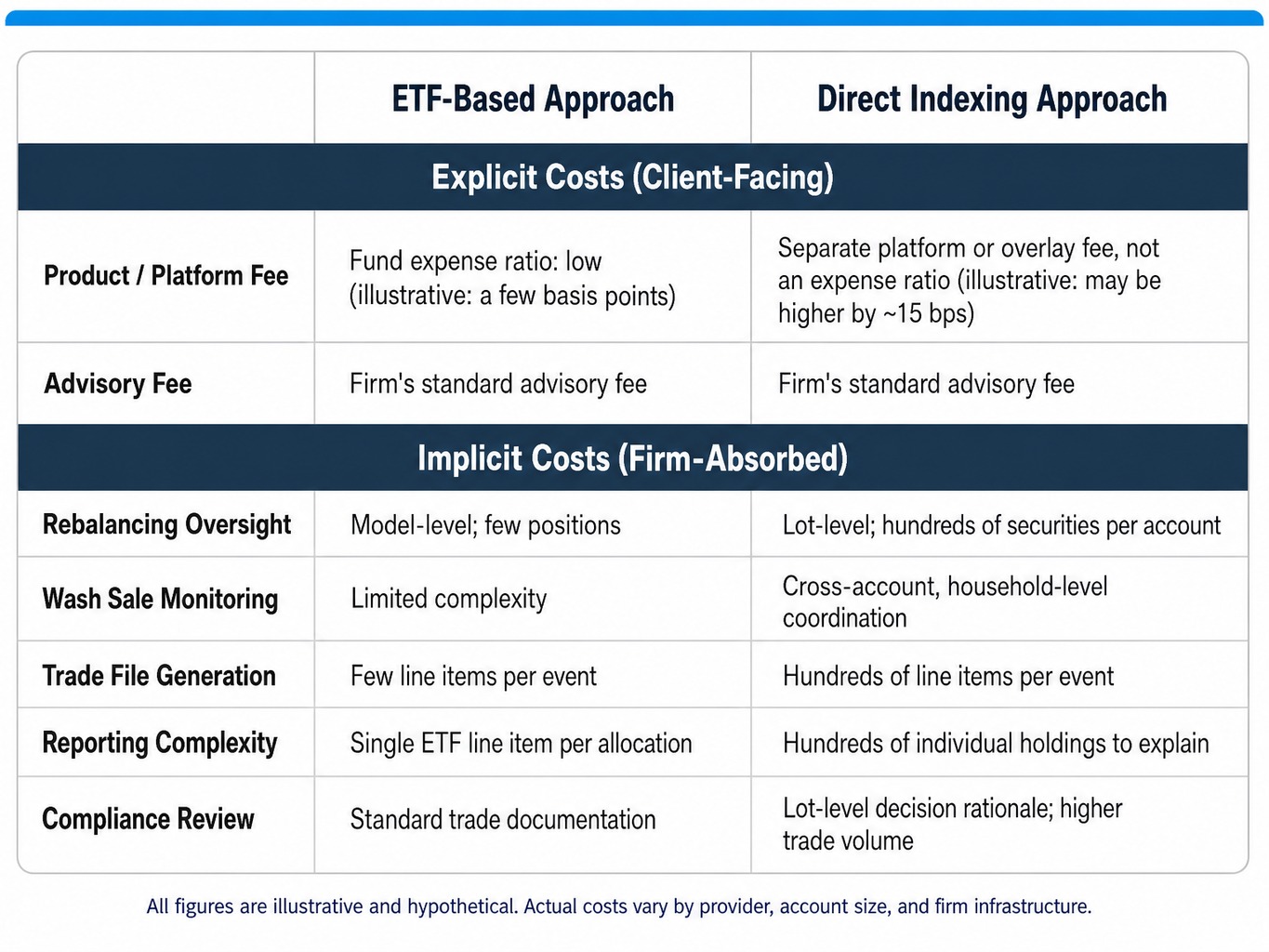
A cost comparison between direct indexing and ETFs is often reduced to a simple analysis of explicit fees. While this is a starting point, it presents an incomplete picture for advisory firms. A fuller total cost of ownership (TCO) evaluation also accounts for the implicit operational costs the firm absorbs to support each vehicle.
For instance, a firm running a parallel cost analysis for a hypothetical $2 million taxable account might find an explicit fee difference of roughly fifteen basis points in the ETF's favor. When the firm also factors in the platform's custody-related transaction costs, the additional time its operations staff spends on oversight, exception handling, and reporting review, and the cost of upgrading its portfolio accounting system to handle lot-level data, the total cost gap could be considerably wider than the fee comparison alone suggests, at least initially. The breakeven point would shift depending on the client's turnover rate and tax situation, which suggests the cost question is difficult to answer at the product level alone. The figures in this example are illustrative and are not drawn from a specific industry research report.
Explicit Fee Structures: What Clients See
The visible fee layers for these vehicles are straightforward. Broad-market index ETFs typically charge expense ratios of just a few basis points. Direct indexing platforms typically charge a separate fee, which can be structured as a technology fee, an overlay management fee for a separately managed account, or a comprehensive platform fee. On top of both sits the firm's advisory fee.
In recent years, more large providers have entered the direct indexing market, and pricing has become more competitive. Where that narrows the explicit cost gap between the two approaches, the implicit, operational costs can carry more weight in a firm's comparison.
Implicit Costs: What the Firm Absorbs
The operational costs of direct indexing may not appear in a fee comparison because they are absorbed by the advisor's time or the firm's operations team. Many specialized direct indexing platforms automate substantial parts of trade generation, lot selection, and account-level monitoring, but the advisory firm still may retain oversight, exception review, reporting, and communication responsibilities. These implicit costs can include:
- Rebalancing Oversight: Reviewing automated recommendations, exceptions, and execution activity across hundreds of individual securities instead of a handful of ETFs.
- Wash Sale Coordination: Monitoring for potential household-level conflicts and coordinating across accounts and systems, particularly when responsibilities are split across multiple tools or teams.
- Trade File Review: Reviewing, approving, or reconciling trade files that may contain hundreds of line items for each rebalancing event, even when a platform generates them automatically.
- Reporting Complexity: Preparing and explaining client statements that list hundreds of individual holdings instead of a single ETF position.
- Compliance Review: Documenting the rationale for lot-level decisions, exceptions, or customization settings and managing the increased volume of trade records.
These activities consume advisor and staff capacity. The "cheaper" vehicle, therefore, depends on whether a firm measures cost at the client level or at the firm level, inclusive of its own operational resources.
Read more: Automation in Wealth Management: Workflow Design and Operational Risk
Operational Implications for the Advisory Firm
The operational implications of direct indexing extend beyond cost to affect how a firm scales, how advisors communicate with clients, and how leadership maintains consistency. While direct indexing can deliver significant value for the right clients, it also increases the operational workload the firm takes on. For enterprise firms with multiple advisors, this raises important governance questions about how to maintain consistent practices when each client's account is unique.
When direct indexing is adopted for a high-net-worth segment, the quarterly reporting workload can change substantially. As an illustrative range, statements that showed 5-10 ETF positions could instead show 200+ individual securities per account. Even when specialized platforms automate much of the underlying trading and lot-level processing, client questions about individual holdings and performance attribution can still increase, adding to advisor preparation time and review demands.
Rebalancing, Drift Tolerance, and Scalability Considerations
ETF-based portfolios are typically rebalanced at the model level; an advisor adjusts allocation weights across a few positions. Direct indexing accounts can involve lot-level rebalancing decisions for each client, including drift tolerance settings, monitoring of the portfolio's exposures relative to its index, and trade coordination with wash sale considerations in mind. Direct indexing rebalancing can also produce many more individual trades to record and review under the firm's own policies than the handful of trades an ETF rebalance involves. Firms may want to work with their compliance professionals to determine how best-execution and trade-allocation reviews apply.
Some firms use overlay management platforms from specialized providers to help automate these decisions. Those platforms may handle much of the calculation, lot selection, and trade construction, but configuring parameters, reviewing exceptions, supervising outputs, and integrating the results into the firm's broader workflows can remain part of the firm's work. The scalability of a direct indexing offering, therefore, can depend on a firm's technology infrastructure and the degree of automation in its rebalancing workflow.
Client Reporting and Communication Complexity
Client reporting is a factor that can receive less attention in the direct indexing vs etf decision. A statement with a few ETF line items is simple to explain. A statement listing several hundred individual securities requires a different conversation. Reporting and analytical tools may need to show why specific securities were sold, why tracking difference exists relative to the benchmark, and how customization choices affect performance.
This presents a challenge for firm-level consistency. Are all advisors explaining direct indexing performance the same way, using the same analytical framework? The communication burden on advisors and on the firm's presentation infrastructure can grow as statements carry more lot-level detail. Even where a specialized platform automates parts of account management, the firm still needs a repeatable way to review outputs, contextualize account activity, and translate it into clear, client-facing summaries.
When to Use Direct Indexing, ETFs, or Both in Client Portfolios
Offering direct indexing does not mean setting ETFs aside. The question is not which to choose universally, but which to deploy for which client segment and account type. A practical evaluation framework can help firms make this determination.
Firms may consider the following factors:
- Account Size: Is the portfolio large enough for a representative basket of individual securities to be practical and cost-effective from an operational standpoint?
- Customization Needs: Does the client have a large concentrated stock position to manage or specific values-based preferences that ETFs cannot address?
- Firm Readiness: Can the firm's operational infrastructure support the additional complexity for that client segment without eroding advisor capacity?
- Tax Status & Tax-Loss Harvesting Potential: Is the account taxable, and does security-level ownership create meaningful potential for tax-loss harvesting or more precise tax-lot management? The potential benefit varies by client circumstances, embedded gains, turnover, and existing holdings, and it is not guaranteed.
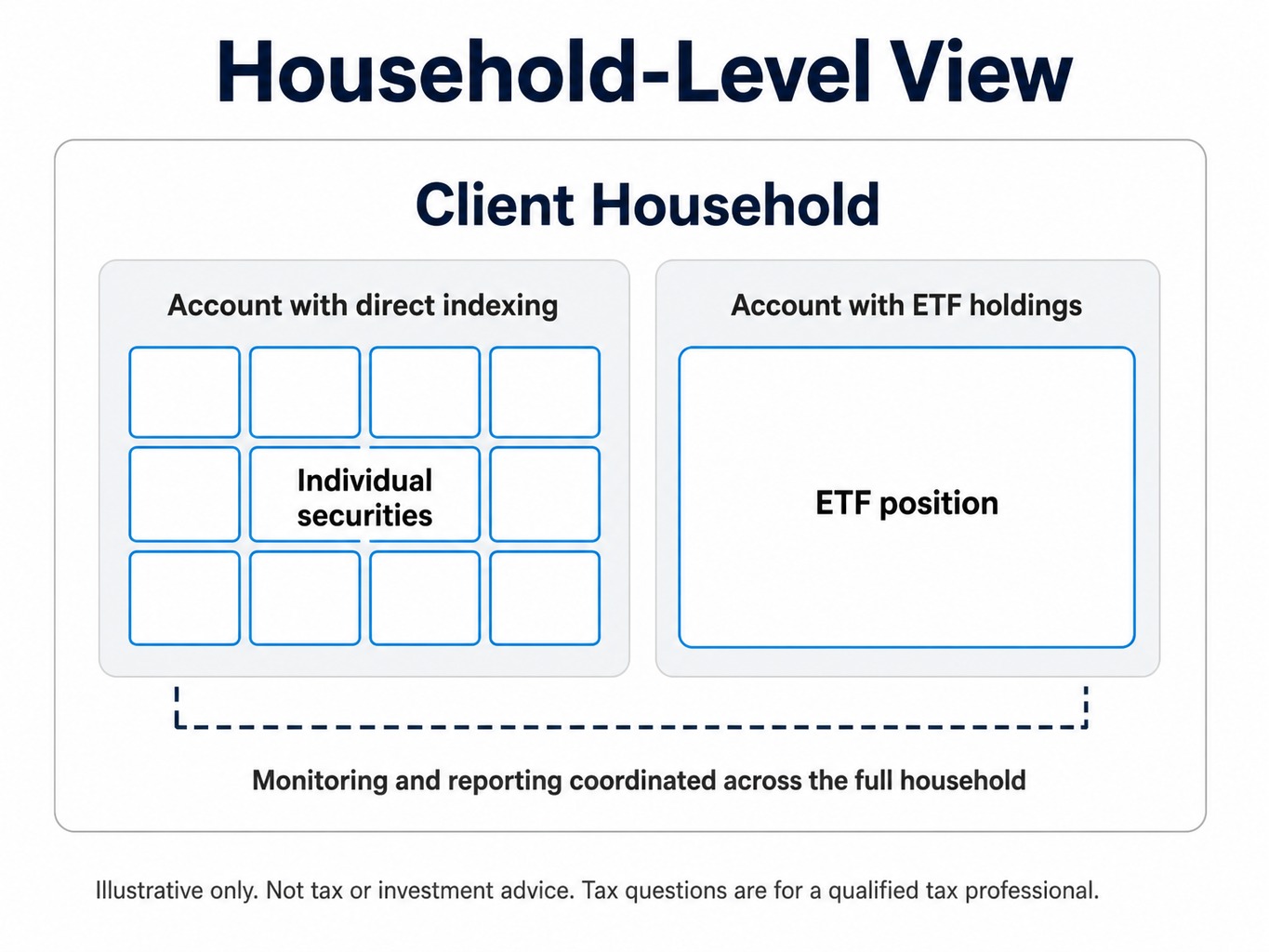
Declining minimum account sizes have expanded the range of clients for whom direct indexing may be technically feasible, but lower minimums do not automatically make the operational case favorable. Household-level coordination is a further consideration when some accounts use direct indexing and others use ETFs. Household-level reporting for these clients can benefit from an analytics layer that distinguishes between overlap at the security level and overlap at the exposure level, since a direct indexing portfolio and an ETF tracking the same index are held and managed differently; how the two interact for tax purposes is a question for the firm's tax professionals. Firms evaluating their readiness to support these workflows may benefit from a workflow-first approach to practice management.
How VRGL Supports the Analysis Behind Direct Indexing and ETF Decisions
The decision to use direct indexing, ETFs, or a blend of both involves operational and communication considerations alongside investment ones. It can involve evaluating portfolios across multiple dimensions, comparing current holdings against proposed approaches, and presenting that analysis clearly to clients and prospects.
When an advisor is evaluating whether to transition a client from an ETF-based strategy to a direct indexing approach, the analysis can involve comparing the current portfolio's characteristics against a proposed model across performance, risk, diversification, tax, and fee dimensions. That comparison typically follows the advisor's own discovery and fact-finding process, where the client's goals, tax situation, and values-based preferences are captured separately from VRGL's analytical workflow. The VRGL Growth Platform is designed to support repeatable acquisition workflows of this kind. Within it, VRGL Core helps advisors move from statement data to portfolio analysis and proposal management without rebuilding the comparison by hand each time.
VRGL's AI capabilities are focused on statement extraction. After data is extracted, the platform helps advisors analyze portfolios through five-pillar comparative analytics and present the findings through branded proposals and reports. It can also support tax transition optimization analysis when a firm is evaluating how an existing portfolio may compare with a proposed transition path. That is distinct from ongoing tax-loss harvesting, wash sale monitoring, or direct indexing portfolio management. VRGL helps advisors evaluate and communicate potential transitions; it does not execute trades or manage a direct indexing strategy.
VRGL does not make the investment decision or recommend one vehicle over another. Instead, it gives the advisor the analytical foundation and presentation materials to communicate their own recommendation with less manual preparation.
See how VRGL supports portfolio comparison and transition analysis for advisory firms.
Conclusion
The direct indexing vs. ETF decision is, in large part, a question of operational readiness and client segmentation rather than a search for a universally superior investment vehicle. Both structures offer distinct advantages. ETFs provide simple, scalable, and structurally tax-efficient market access. Direct indexing offers granular, account-level control and customization at the cost of greater operational complexity.
The firm's ability to support lot-level management, absorb reporting complexity, and maintain a shared analytical and presentation baseline across advisors is one important factor in whether a direct indexing program adds value for clients or creates avoidable operational friction. As minimums continue to decline, the question for advisory firms is shifting from "can we offer this?" to "for which clients, and at what operational cost, does this make sense?"
Frequently Asked Questions
What minimum account size tends to make direct indexing practical compared to an ETF?
Minimum account sizes for direct indexing vary by provider and have generally declined as fractional share technology has become more widely available. Even so, firms may want to evaluate whether the operational cost of managing a direct indexing account is justified at lower account sizes, even when the technology permits it.
How do wash sale rules affect firms that use both direct indexing and ETFs across a client's household?
Household-level coordination can be important when a client holds both direct indexing and ETF accounts, but the tax treatment depends on the specific securities involved and the accounts in which transactions occur. Overlapping ETF holdings do not automatically create a wash sale. Whether a transaction is treated as substantially identical is a question for a qualified tax professional.
Does direct indexing offer advantages in tax-advantaged accounts like IRAs?
The considerations associated with direct indexing's lot-level control can differ between taxable and tax-advantaged accounts, and a qualified tax professional is best placed to assess how they apply to a given client. Separately from tax considerations, customization features such as values-based exclusions may be relevant in tax-advantaged accounts like IRAs. Firms may treat account tax status as one factor within their broader segmentation framework.
What compliance considerations may arise when a firm begins offering direct indexing?
Direct indexing can introduce compliance considerations that ETF-based models may not, including documenting the rationale for security exclusions, monitoring wash sale activity, and ensuring consistency in how lot-level decisions are made across advisors. Firms may want to evaluate whether their existing compliance workflows can accommodate this additional granularity before expanding their offering.
How does tracking difference in a direct indexing account compare to tracking difference in an ETF?
ETFs generally have low tracking difference, driven by expense ratios and sampling. Direct indexing accounts can experience wider tracking difference because of customization, exclusions, and the timing of lot-level trades. Reporting that shows tracking difference ranges and how customization choices affect benchmark-relative performance can support these client conversations.
What role does direct indexing play in ESG or values-based portfolio customization?
Direct indexing allows advisors to exclude specific securities based on a client's values, for example, removing fossil fuel producers without altering the rest of the index exposure. While ESG ETFs offer a simpler alternative, they apply a standardized screen that may not match an individual client's preferences. Direct indexing provides more granular control at the cost of higher operational complexity.
This content is for informational purposes only and should not be considered investment, legal, tax, or compliance advice. VRGL does not provide investment, legal, tax, or compliance advice, and does not assume any liability for the information provided herein.